The AI Journey

The past few months have been a little different in terms of my learning journey. This time last year I felt as though AI was in its infancy and it would be another fad that passed us by but then I began to use it. I could see that it was useful on an individual level and never for a minute thought that it would explode through businesses in the way that it has.

There has been massive pushes towards integrating AI into our daily workings in the business where I am currently contracting. CoPilot, Jira AI, Internal AI systems and call transcribing systems have all been integrated and people are using them to get great results. I even heard a team discussing how AI transcribes their calls and gives them actionable outputs that the teams can use in their Sprints. Other teams have been discussing how they can use AI to create Gherkin Specs for their automated tests and Acceptance Criteria or even write stories for them! I never saw that coming but it is great that people now have the courage to push themselves outside the norm and experiment with things like this and companies encouraging it can only be a good thing.

It was time for me to learn more and hopefully help the Leaders, Teams, Scrum Masters and Product Owners that I work with embrace this more. Scrum Alliance have been working hard to produce micro credentials to help up skill people in their use of AI. These micro credentials have helped me get a good grounding on the tools that exist, how Product Owners and Scrum Masters can use them and they also give you some great hand outs to use, covering different types of prompts and how to craft them for your needs. The ones that I have completed are below.

The micro credentials were great but nothing beats a bit of trainer led content and I was lucky to be invited along to a session organized by Scrum Alliance with John Barratt on “Getting started with AI Prompt Engineering” and it really brought home the importance of spending time crafting your prompts with the desired level of detail, using the AI tool in a specific role and maybe giving it your train of thought to help you get the most suitable results.

John is a great trainer who is really knowledgable on AI having been working in that field for a number of years so it was great to listen and be taught by someone who knows what they are doing and this really helped fill the gaps in my thinking and knowledge. I will admit to being a bit of a “Warrior” back in the early days (alright, maybe a couple of months ago!) who would fire up ChatGPT and ask it a wide ranging question and then curse it as not knowing what it was doing when it didn’t give me the exact results I wanted (we have all been there). The micro credentials and the trainer led course really brought home where I was going wrong in the past, how much I have improved and gave me more knowledge to push on further and help others who may be going through the “Warrior” phase.

So where are we now? Will I be changing my Linkedin title to AI Guru? No. AI Warrior? No. Am I more equipped to help people embrace AI and how it can support them in their day to day role? Yes (see how I used the word “Support” there, I feel that AI is here to support us rather than replace us 😉 ). Never for a minute did I think that this time last year I would be sitting here on a Saturday morning writing about how I am embracing AI but here we are.

  • You will notice the featured image, well, when I decided to post WordPress asked me if I would like it to generate an image based on my blog post. Here is the prompt it generated!
  • “Create a featured image for a blog post titled “The AI Journey.” The main subject should be a diverse group of professionals engaging in a collaborative discussion about AI tools in a modern office setting, illuminated by warm, natural light. The scene should incorporate elements like laptops, AI interface screens, and vibrant charts to highlight the integration of AI in business. The style should be contemporary and professional, capturing a sense of enthusiasm and innovation among the team members. Please ensure the image is high resolution, highly detailed, and in sharp focus to convey clarity and engagement”

You can find Scrum Alliances range of micro credentials here. I am even sanctioned to train some of these and you can find them here if interested. Although, there will be a blog post on this coming soon.

Certified Scrum Alliance Trainer

Well, this is a post that I never thought I would find myself writing. When I look back to when I obtained my CSM back in 2008 the first thing that I did was enquire about becoming a trainer, I wanted to share my knowledge with people but back then the problem was that I didn’t have enough knowledge or skills to really make this work. I had been working in the same role for a couple of years and the advice I was given was to “go and learn my trade, build up your stories, your skills and examples as you will need them for when you do become a trainer”. I put this into the back of my mind for a long time (nearly 20 years) but today the situation finally changed. I do have these skills, experiences and stories and I passed my Certified Scrum Alliance Trainer certification.

When Scrum Alliance announced that they were having a pilot process to bring Certified Team Coaches into the CSAT program I was very interested in taking part. There was an application process where there was a certain amount of places on a first come first serve basis and I will admit I had the application filled out ready for when the clock struck on the opening for the pilot. I was over the moon to get accepted and was given the relevant documents to prepare for my practical Trainer Skills Assessment (TSA).

The skills assessment is facilitated by the Trainer Approval Committee (TAC) and on the day there were 4 members of the TAC who joined the Skills Assessment. They would not only be participating as interviewers but also as students in the simulation that is part of the TSA so as you can tell it is pretty involved.

The basis of the TSA was a training pack that had 13 Learning Outcomes (LO) with an accompanying online learning Microcredential. I had to prepare 13 approaches to physically complete a learning outcome within the 20 minutes. The outcome of the LO must have been carried out and the students should leave being able to do the action that you have taught them. The TAC could ask for any one of these LO’s to be performed so studying and learning each approach is a must but the TAC want to see how you react in the moment so your approach needs to be fluid and non scripted as they want to see how you perform at the task, not how good you are at following a script.

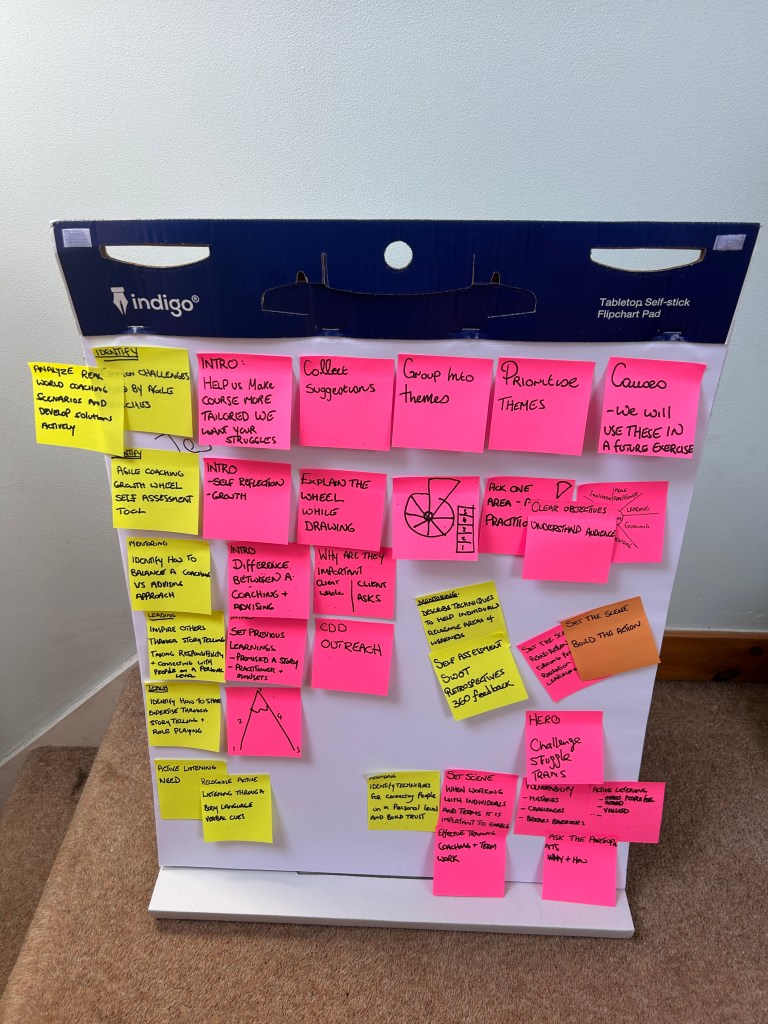
Preparing for the TSA was tough. There were different outcomes like Identify, Coach, Mentor and Teach which all needed their own approach and different practical exercises and they needed to be achievable in 20 mins which was tough, one tip here that I would give is to try and nail your content in 10 minutes to allow questions and interjections, don’t take your exercise or content up to the 20 minutes as you will need to allow for interaction to show your training style. The format of the TSA is all manual tools too so no Miro / Mural, breakout rooms, etc so make sure to leave time for you to write out any post it notes if these are needed for your exercise. I used the old traditional flip chart, post its and pens. Be mindful to schedule an equipment test with Scrum Alliance to check that your set up is correct, the users can read your flip chart if using one and make sure that you flip the camera on Zoom so that people can read without it being mirrored.

The TSA started off with a 20 minute interview about my Agile Journey, my teaching style and who I am as a person. There were a couple of really good questions in there that made me have to stop and think about how I would approach them. I really appreciated these questions as I felt a sense of achievement that I had answered them really well. The whole TSA was a nerve wrecking experience for me coupled with the uncharacteristically great weather here in Glasgow as well as having my office in the attic and a neighbour who took the opportune moment to mow their garden which meant I had to have the windows shut! I looked on in the zoom window and could see my face get deeper shades of red as we went on but thankfully this didn’t slow me down any.

The practical exercise was a good test of my preparation and although there were a couple of things that I could have done better, I got to a good outcome in the 20 minutes allowing for interaction and Q&A. Taking the time to test positioning of the flip chart, the camera, the post-its etc really paid off as if anything didn’t go to plan here I would have become flustered and would have likely not met the outcome. Also, you are in charge of your own timer so test this too, I used the Apple Watch for this but I had to create my own 20 minute timer as there wasn’t a preset for 20 minutes frustratingly. I managed to finish within the 20 minutes and admittedly the LO I was given was one that I hadn’t prepared a lot for as I thought to myself, “they won’t ask me for this one” but turns out they did.

The TAC were very friendly and pout me at ease and gave me some great, useful feedback after telling me that I had passed. I will begin to put this into practice in time for me being assigned the learning that I am able to provide so I am looking forward to that!

Currently there are 32 CSAT’s in the world and none in Scotland so I feel that little bit special at this moment in time. I have a couple of days holiday to allow me to spend some time with my wife and daughter who I have neglected whilst preparing for this so I am looking forward to some time to chill and plan my next steps.

Agile Coaching Trainer Pilot

When I obtained my Certified Team Coach from Scrum Alliance, never for a minute did I think it would be retired so soon. There are big changes happening within the coaching certifications with the Guide level certifications (Certified Team Coach and Certified Enterprise Coach) being phased out in favour of a new Certified Agile Coach certification. The CAC will be aimed more at the practitioner level of the Agile Coaching Growth Wheel.

With that, Guide level coaches will still be allowed to use their advanced coach certification badges but we will be given the CAC badge also. I haven’t been briefed about what the CAC process will entail but Scrum Alliance have now released a few self led micro-credentials based on coaching topics like Introduction to Agile Coaching and Becoming an Agile Coach to let people learn at their own pace.

Recently Scrum Alliance reached out to the coaching and training community to give us the chance to take part in a pilot that would allow people to teach these modules in person as part of the Certified Scrum Alliance Trainer (CSAT) programme. I applied and I was accepted onto the pilot!

I now have a Training Assessment Course to look forward to with members of the TAC Team which I will admit, I am really nervous about. Being able to train confidently was on my personal improvement list as I am usually more comfortable working with teams and practically showing how things are done rather than providing training to large audiences. It is something that I need to overcome to grow as I know all of the content better than the back of my hand, I just need to overcome the lack of confidence to push myself forward.

As I have done with my CTC, I will thrown myself in at the deep end with this one and document everything as I go along. I am looking forward to the feedback and builds that will no doubt come my way to make me a better trainer.

Here goes! Wish me luck!

The Power of Metrics (measure what matters)

Metrics have been a bit of a hot topic at work recently and having applied to be a part of Scrum Alliance’s team of experts for the new Metrics course they were putting together I thought I would write down some thoughts on what I was seeing in the metrics space. I began writing this post but it took more of a personal note as I was writing and I decided to go with it. I then wondered if I should actually post it at all. I got word back from Scrum Alliance today that I have been selected as part of the review panel which is exciting and it drew me back to this post again and whether I should publish it. Here goes……

Anyone who has worked with me will know how passionate I am about metrics as a Scrum Master and a Coach. I come from a time where we didn’t have Jira, VSO, AgilePlace and the likes. Everything was done via index cards and Excel Spreadsheets! This method, although time consuming taught me about trends in the charts, how to interpret them, when to ask questions or when to support the team if things seemed to be slowing or blocked.

Using the information in front of you and questioning when things don’t seem right is essential.

This came true for me in a personal sense last summer when I was pushing myself in my training. I would hit the gym before work, jump on the bike at lunch for some mental heart busting training programmes and then take the dog a long walk in the evening or go for a run. I was probably in the best shape that I had been for a while. I would keep an eye on key metrics such as heart rate, heart rate training bands, resting heart rate and HRV. I looked at these as if they were metrics that I would pull for my Scrum Teams. I looked for trends, areas of improvement and times where I had maybe been pushing too hard and needed to draw back a little as I was over committing.

The day before I went on holiday, out of the blue, I woke up to my Apple Watch telling me that my heart had been in an abnormal rhythm overnight. It stayed that way for the entire fortnight holiday and beyond. The metrics were showing that my heart was in a normal rhythm (Sinus Rhythm) throughout the day but as soon as I would drift off to sleep it would kick into AFIB and last until I woke up, sometimes it would be 12-14 hours per day. There were patterns, there were outliers but I was able to use the metrics available and the tools available (the ECG) to gain valuable data.

Just like in my Scrum Master days, the watch gave too much data. I was overloading myself with all different aspects that the health app could give me. I had to measure what was valuable and what really mattered. As a Scrum Master you need to decide with your team what matters, what is valuable and what helps improve your team. Too much data can lead to you focusing on the wrong things, the unimportant stuff that isn’t going to move the needle or drive the team forward. For me, too much data in this case overloaded me and I spent most of my holiday over analysing every symptom, every irregular beat and came home with a list of causes longer than my arm, most of which I never really knew where to start fixing.

Like a newbie Scrum Master, I took every ECG, every chart, symptoms, you name it, I had it and I made sure the Cardiologist had it. The surprising thing for me was he knew what mattered, what data to use to get to the right diagnosis and action. He measured what mattered. This is the skill that I try to install in my Scrum Masters. Measure what matters, it will help you help your teams to improve quickly without having to sift through a mound of data that you just don’t need.

For me, I am back in the inspect and adapt phase and measuring what matters as I try to get my fitness back to near where I was before this kicked off and try and manage AFIB as best as I can. I have good days and bad days but the drugs seem to be working but I am not pushing myself as hard as I used to just in case. I’ll be taking the data back in a few months and hopefully we can get a solid solution.

The Apple Watch is an awesome piece of kit, without it I would be lost.

Think what is important for your teams, how would you analyse the trends and use this with your team to drive improvements. What important health metrics are you tracking? Look after yourselves and your teams.

The AI Scrum Master

AI has been on the tip of everyone’s tongue this year. It seems to have really progressed and the number of tools available like ChatGPT, CoPilot, Otter.AI etc seems to have grown.

I first used Otter.AI as part of the submission process for for my ICF-ACC examination. I found it really helpful for transcribing the coaching session accurately. The tool was able to differentiate between the coach and the coachee really well. I knew that this would be a tool that Scrum Masters would be using soon enough. How soon really surprised me!

My second brush with AI was in a group meeting where one of my colleagues gave us a running demo of ChatGPT. We were refining our prompts and decided to make up a fictitious problem and have ChatGPT create us a backlog. It did this with ease from epics, features down to User Stories complete with Acceptance Criteria. We then asked the tool to export this into a format that we could upload to Jira. The export was done with no issues. This peaked my interest and I had to find out more.

I recently took the AI for Scrum Masters course from Scrum Alliance and found it really insightful. The course provided an in-depth look at some of the different AI tools that are available. It put them into context and showed possible uses for the Scrum Master to become more efficient in their role.

One example that really stood out for me was the use of AI in Scrum Events. Having an AI tool transcribe the event for the team means that there isn’t an over reliance on everyone taking notes and distributing them. Using a tool, such as ChatGPT, the Scrum Master can craft some prompts to extract key actions or events to distribute to the team. It sounded great but I didn’t see this being utilized in our organization any time soon.

Imagine my delight today when one Scrum Master demonstrated this exact scenario and showcased the time saved using AI. He used Zoom to transcribe one planning session. He uploaded this to CoPilot and asked the tool to pick out the action points and key insights. He then asked CoPilot to create an email outlining all of the actions and key insights. He then copied and pasted the output into an email and sent it to the team. This saved 20 minutes on the email alone!

There are some great use cases contained within the Scrum Alliance training and it is well worth looking at. I hope to begin experimenting with AI in a workplace setting soon with the view of evolving with the times and supporting our Scrum Masters and Product Owners embrace this new way of working.

Can it replace the Coach or Scrum Master? I would say no. It is a great too for supporting these roles but the benefit comes from the person who is able to take these outputs, interpret them and then tailor the outputs for the context or situation that the team is working on empathetically.

My journey to CTC .. Complete!

Well, what a journey! 5 years ago I posted that I was picking up my CTC application again after I rage quit the process when Scrum Alliance changed the application pathway as I was half way through my Certified Scrum Coach application and replaced it with CTC / CEC.

I was at risk of this happening again as Scrum Alliance are changing the CTC / CEC process and if I didn’t get this over the line I think it would have been the end of my relationship with Scrum Alliance 😀

Yesterday I got confirmation that I had passed CTC and I was over the moon. It has been the most challenging certification I have done as it took a lot of brainpower, reasoning, writing, rewriting and questioning if my approach to each scenario was the right one. It pushed me way out of my comfort zone.

It challenged me more than any other certification and shows the value of having a rigorous process. Employers can be sure they are getting the best people and I have gained a lot of respect for my peers who have been through this process before me due to the dedication that it takes to obtain this. It isn’t a 2 or 3 day course with a small exam at the end. It tests your approach to coaching scenarios and not only how you succeeded but also how you failed in certain scenarios, what you learned and how you improved.

So what is next… I still fancy cracking the CEC certification but I want to explore the benefits that the CTC certification brings. Currently I am mentoring SM’s and PO’s and preparing them for Scrum.org certifications as this is the certification body that they have chosen. One of the benefits of CTC is that I can nominate the people who I am mentoring to enter directly to the exam stage to gain their Scrum Alliance certifications for SM and PO as I hold both of these certifications. This will be a massive change for me as I can offer this and not feel like I am feeding the other side of the fence anymore!

Lots to explore and lots to report back on, especially the changed to the coaching certifications that Scrum Alliance have in the works!

CTC Part 2 Complete

Nothing like putting a rocket up your backside to get things done, eh, Scrum Alliance!

This week Scrum Alliance announced that they were retiring the CTC / CEC application process in January. I will leave my frustration out of this for now but I am glad that I have managed to get the CTC part 2 over the line a few minutes ago.

What did I learn from this process. Trying to be concise and keep the vast amount of knowledge I have in coaching teams and leadership within 600 words is a complete nightmare! I deserve extra credit for this if I am honest 😀

It has taken a long time to write, rewrite, realize that I was over the limit then try to cut out words and rewrite sentences to make sense, I probably put too much thought into it but it has definitely been the hardest certification I have done so far.

Now to click “Send Entry” and await feedback! It feels good to get this done and it has been a massive learning journey over the years.

More to come when I get feedback…. fingers crossed!

My journey to coaching

This has been a post that has been a long time in the making. I often reflect back on how I have come to be in the position that I am in at the moment. I have been really privileged to have worked for some great companies so far that have allowed me to learn, progress on my journey and meet some great, knowledgable people along the way that have really pushed me to where I am now.

While I was at University I worked in a bowling alley. I was promoted to a Team Leader and this role taught me a lot about collaboration, team training, satisfying the customer and to think on my feet to bring a team together to solve problems and keep them effective. Do these qualities sound familiar?

When I graduated I found myself moving into a Software Development role and then quickly moving to a small startup in Glasgow to work as a Software Tester. We were working in a Waterfall environment and being last in the chain meant that we would see things sprung on us to test quickly. It was stressful, long hours and other than working in our testing silo, it didn’t feel very collaborative. I left work on the Friday and returned on the Monday to find our world had been turned upside down!

As we assembled on the Monday morning we were all lined up. Our names were called along with a team name. I was put in Team A (very imaginative) and was introduced to this new thing called “Scrum” and “Extreme Programming”. Now, in 2006 there weren’t many people doing Scrum, well, in Glasgow at least and these new roles felt quite alien at the time. They had funky titles like “Scrum Master” and “Product Owner” and I couldn’t help but think that this was a fad and it would all go back to the way it was in a few months or even weeks. As we gained experience as a group we improved. As a tester I became more involved in discussions that I didn’t know happened as I had never been exposed to Developers, Artists, Graphic Designers, Infrastructure experts. This was mind blowing. We started to deliver things quicker, there were less bugs as things were being picked up earlier in the process and the late nights had gone. It was life changing!

After a few months I was honoured when the team chose me to be their new Scrum Master, this was where my journey began. I was mentored by an awesome person called Mel Lang who is still on hand when ever I need her and she really grounded me and taught me the ropes of the role. The feedback and advice she gave me in those early days really set me up for success and the teams and individuals I worked with really pushed my to become the best Scrum Master I could be.

After some time I was sent on a Certified Scrum Master course with two awesome trainers, Tobias Myer and Mike Sutton. I remember returning from that course with a feeling like no other. A feeling that I could change the world! I have since learned a lot of people get that feeling. After the course I emailed Mike to start this world changing journey. I wanted to do what he did, teach people about Scrum. He gave me the best advice anyone in his position could. “What is the rush, stay where you are, learn your trade, success will come”. That is what I did. If there is one thing you will learn, it is that you don’t stop learning. There is always something that you could be doing to better yourself or your teams and that piece of advice stuck with me to this day as I keep on learning my trade.

Those experiences in the early days led to me having a really grounded experience of Scrum, Kanban, XP and a load of stories to tell around how our teams overcame major problems, conflict, leadership woes and delivered really good products that our customers loved. I was quickly learning that stories were a useful part of a Scrum Master’s toolbox and the only way I was going to get more was to move on and use my experience in other companies.

I moved on to become a sole Scrum Master at a pensions company and they really invested in me with my CSPO and allowing me time to practice and learn towards my CSP certifications. Working over multiple teams where we perfected the basics of scrum and really pushed the boundaries to move towards scaling (LeSS, like) and using the latest technologies and cloud transformation really pushed me on to the next level. Working to try and solve large scale problems that were slowing the business down and helping teams implement the improvements to the issues we uncovered really helped uncover a layer of the business that I hadn’t experienced before, one that I began to really enjoy.

After a few years it was time to move again and take those stories with me, I moved to a consultancy and found myself tasked with being a Scrum Master in a scaled environment. Working with teams and teams of teams was challenging but rewarding and this would set me up well for Scaled Environments. The key here was collaboration and relationship building. The effort put in here helped exponentially when it came to unblocking issues for our teams. Resourcefulness is one key aspect I think that most Scrum Masters miss out on and they really should try and master this skill. If your team are stuck, knowing the best person to speak to and ask a favour of is so valuable in getting things moving and back on track quickly and this is ever so valuable in a scaled environment.

I had been working with a few people and helping them with some troubles that they were having in their Scrum Teams. One person referred to me as their Coach and this intrigued me. In all of time I had been working with Agile teams, I had not come across a coach before. Back in those days we had very knowledgable people who you could rely on for insights or troubleshooting if you were really stuck. Soon these people moved into Coaching Roles and I had an idea in my head of the level of experience you had to be at to move into these coaching roles. I had a high barrier based on the people I looked up to.

Fast forward a year and I was given the chance to move into a permanent coaching role and the best thing … a few of the people that I looked up to were also employed as coaches in that organisation, win win!

I have never looked back. Being trusted to work with teams, individuals and leadership on large scale transformations based around Scrum, Kanban and SAFe has really pushed my boundaries. There have been times I have asked myself if this role is really for me, times when there have been conflict between individuals, bad behaving teams and leadership challenges but taking a step back and finding my own way to navigate these challenges practically has been one of my super powers of late. I have found that having a great team of Coaches has helped push me on further as we learn from each other and collaborate to move the business forward for our customers. This has been a brilliant learning experience as not only am I helping others but people have been testing me, pushing my boundaries and making me learn more so that we can be an effective unit together.

The coaching role has really evolved in the past 5 years, so much so that if you stand still it will steamroll you over. In the beginning teams and individuals had a thirst for theory and knowledge now they have progressed past this to the need for practicality. Show me how to do this, show me how to do that is the norm, the skill is now trying to intertwine the theory with the practical side so that people are learning as they do it. As a coach from a practical background I feel that I would struggle in an Agile Coaching role if I couldn’t walk the walk. Mentoring and teaching are two of the major stances that I use with my teams these days and it can be tiring but rewarding when everything clicks into place and the “aha” moments occur.

I started to look into the ICF-ACC credential as Scrum Alliance stated that you must be able to evidence that you can coach at ICF-ACC level as part of their CTC application. I have not looked back since! This has widened my ability as a coach and how I interact with individuals and teams. I was never comfortable being outside of the mentor / advisor states as these were my go-to stances as a Scrum Master, using these to solve issues and work effectively with teams on a day to day basis. I found myself struggling to find the right approach when dealing with individuals, teams and leadership where I couldn’t solve the issues or jump in and guide a team from the front. The professional coaching stance has helped me to step back and trust that teams have all of the skills and answers to their problems, I just need to help them uncover the solutions through the correct approach.

What is my advice to people hoping to move to an Agile Coaching role now? Learn your trade. Too many times have I spoken with Scrum Masters who are new to role and asked their ambition to be told that they want to be an Agile Coach right away. Don’t wish your life away, take the time, experience a few different environments, different sets of people, find your own stories. Find a mentor or someone who would be willing to help you make sense of your experiences and validate your knowledge. You will know when you are ready.

It has been hard to put this journey into a small post. A journey that is nearly at its 20 year point. You would think after this long I would be an “expert” at this but the truth is, you never stop learning. Scrum Mastery, Product Ownership and Coaching are more involved than a 3 day course. Your journey starts after these courses and you get out, what you put in.

* this will probably be a living document as I remember things and chop and change 😀

CTC Part 1 Pass!

A quick update and a change of plan. I changed track back to CTC as this seemed the best fit for where I am in my coaching journey at the moment.

Currently I am about to sit my ICF exam to gain my ICF-ACC and the CTC guidelines state that candidates should be able to coach at ACC level. I have all of the boxes ticked here, having been through the practical interview so that would make the CTC process more applicable and more likely for me to achieve at this moment in time. The CEC requires me to be at ICF-PCC level (although not certified) but I need a little more practice to get to this level.

With that in mind I switched back to plan A and submitted my Part 1 for CTC and I am over the moon to say that I passed and was given the go ahead to progress with part 2! I had a couple of minor items that I had to rectify but the process was really smooth and the reviewer was really efficient too. The review process took 2 days including the items that I had to rectify which was awesome.

So what did I have to rectify. One was minor, I had not calculated the number of hours / days that I had spent on training courses. This was rectified by including the number of hours and number of days as well as the dates.

The second was around my calculation of coaching hours. This was always going to be a hard one and flag up as the role that I currently do across leadership, teams and individuals often varies. The way to stop this flagging is to show your working alongside the description of the work that you do. I know that the word limits are tight, very tight in some cases but showing how you came to that figure helps greatly.

Onwards to Part 2! Hope this helps anyone who is going through the same process.

Coaching Progress!

As we reach the half year point I thought it best to give a progress update as a few people have been in touch regarding the CEC and CTC Journeys and I didn’t want to leave things in the balance.

Having spent a lot of time and focus on the Scrum Alliance CEC/CTC journeys, finally getting my part 1 application over the line has been a massive weight lifted. There are some technicalities I need to work out there but I am awaiting feedback, hopefully I will have some news on this soon.

I haven’t written a progress update before and it feels a little weird that there is progress. Usually I have prioritised something for work, some learning or talked myself out of being good enough to reach these certifications and put them on the back burner again but last week was a massive week and it has given me some extra fuel to write this post!

I actually came to a realisation this week. I have been a coach for a while now and have seen the coaching role evolve, especially Agile Coaching. I have trained Scrum Masters, Coaches, Teams and Individuals in Agile ways of working but I was conscious that I didn’t have any formal education in coaching and I wasn’t certified. Now, we can get into the ins and outs of certifications at another time but to the outside world I probably would have been viewed differently in the expertise stakes and that didn’t sit right with me. An opportunity arose to join a cohort of great people on a coaching course and I jumped at the chance!

This wasn’t your usual 3 day course where everything is rammed in and you are given a badge on your way out, bamboozled by what you have just learned and how you can use it. I spent the past 8 weeks on a Saturday evening being taught by Karen Bruns at Monarch Coaching where I learned loads and had a week of reflection, experimenting and innovating before the next session arrived. This really suited my learning style and was a massive bonus for me! The experience and story telling of Karen and my cohort really helped the learning stick and the final presentation really pushed me out of my comfort zone and taught me a lot about myself (and my attention to detail :D). I would whole heartedly recommend Karen and her courses as she has a wealth of knowledge and practical experience to share. I walked away with a few more tools, a few more tricks and knowledge and my first Agile coaching Certification!

Further to this, I have been working with Lucia Baldelli on my professional coaching certification (ICF-ACC) over the past 2 years. This has been a great pathway and I have documented how this has helped me as a person and a coach in past blogs. With the CEC/CTC application out of the way I was able to prioritise this again. Lucia has been fantastic and invited me along to resit the mentor sessions for ACC again for extra practice and this week I passed my ACC recording alongside a few people from the cohort too! Exciting times and just the small matter of a 3 hour exam to sit to get another coaching certification! I best get studying!

A friend and mentor asked me this week, what do you see yourself using these certifications for? It was a great question and the answer is at the beginning of this post… The evolution of the coaching role. You see, 5 years ago Agile Coaches were usually brought in to work at team level. We would be mostly in the teach and coach space as that was what was required. You would be lucky if leadership was in scope. Now, the role has grown, the expectations have grown. We work across and down the organisation from leadership, strategy, funding all the way down to the individual and having that professional coaching toolset / mindset has really helped me move forward. The days of spouting theory at people and hoping it will stick are gone. Partnering, listening, guiding, supporting and teaching have become the new norm in my experience and my approach has evolved over the years with my new learnings.

Anyway, I have gone on for too long! This was supposed to be a quick update :D. Hopefully I will have more to update on soon.